
AI Drug Discovery: What's the Deal?
The molecule was never the hard part.
AI has answered the question it set out to answer: algorithms can design drug-like molecules, and they clear Phase I at rates far above the historical average. But the molecule was never where the value sat. It sits downstream, in the clinical, regulatory, and commercial machinery that turns a candidate into an approved, reimbursed, prescribed product, and that machinery looks almost exactly as it did before AI arrived.
For most of the last decade, the bet on AI in drug discovery was that software could find better candidates faster than medicinal chemists working by intuition and brute-force screening. That bet has largely paid off. AI-discovered molecules now clear Phase I at rates of 80 to 90 percent, against a historical industry average closer to 40 to 65 percent. The number of AI-originated candidates in clinical development has gone from three in 2016 to more than 170 by early 2026. On the narrow question the field set out to answer, whether algorithms can design or identify molecules with drug-like properties, the answer is in.
The problem is that the molecule was never where the value sat. It sat downstream, in the clinical, regulatory, and commercial machinery that turns a promising candidate into an approved, reimbursed, prescribed product. That machinery looks almost exactly as it did before AI arrived.
The Phase II wall, and what it tells us
The clearest signal comes from the data itself. AI-discovered drugs sail through Phase I, then revert to the mean. Phase II success rates for AI-originated molecules sit around 40 percent, statistically indistinguishable from the traditional industry average, albeit on a small sample. As of mid-2026, no fully AI-discovered, AI-designed drug has been approved anywhere. One asset, Insilico's rentosertib for idiopathic pulmonary fibrosis, has published positive Phase IIa proof-of-concept in Nature Medicine, and that single readout is treated across the sector as the validation event. One drug, one mid-stage result, after more than a decade and over eleven billion dollars of venture capital into the category in 2025 alone.
The honest reading is that AI compresses the part of drug development that was already the fastest and cheapest. Target-to-Phase-I in 18 months instead of five years is a real achievement, and it changes the economics of the discovery stage. It does nothing for the part that actually kills drugs and consumes capital, which is everything that happens in human trials and in the years of regulatory and market-access work that follow. A faster route to the starting line is worth something. It is not the same as winning the race, and the industry is starting to ask out loud whether AI is delivering better outcomes or simply faster failures.
Where the money actually changes hands
Follow the deal structures and the gap becomes impossible to miss. The headline numbers in AI discovery partnerships are enormous. Isomorphic Labs signed Eli Lilly and Novartis in early 2024 for close to three billion dollars in combined upfront and milestone value. AstraZeneca put 110 million dollars down and as much as 5.2 billion on the table with CSPC. XtalPi's 2025 agreement with DoveTree reached toward six billion in potential milestones.
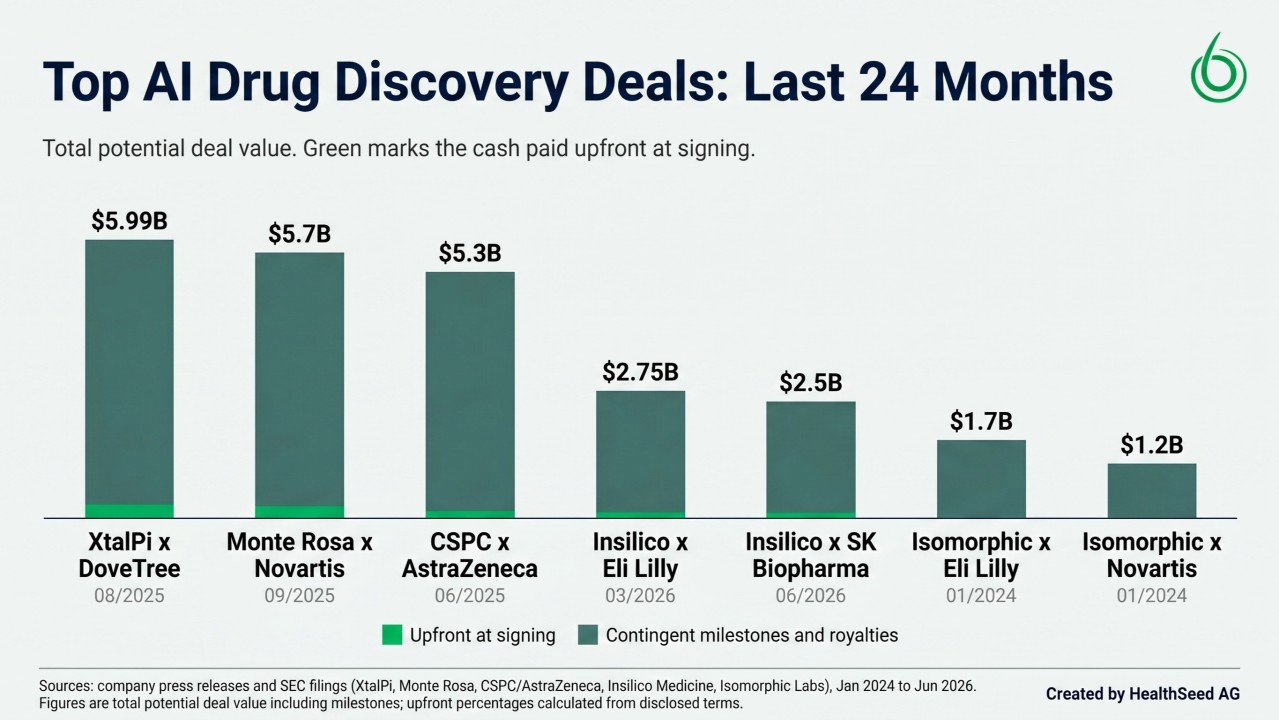
Read the terms rather than the headlines and the picture inverts. The upfront payment in these deals typically runs 5 to 15 percent of the headline figure. The remaining 85 to 95 percent is contingent on milestones the AI company does not control, because in almost every case the pharma partner takes the asset through clinical development, regulatory submission, and commercialisation. Isomorphic, the most richly valued company in the field, does not sell drugs. It sells research partnerships in which its engine designs candidates and someone else carries them to patients. Its revenue is milestone income, and the milestones belong to whoever owns the downstream path.
The cautionary cases reinforce the point. Recursion has spent more than a decade and over a billion dollars to advance a pipeline that has not yet produced a commercial drug, and spent 2025 discontinuing and out-licensing programmes after its merger with Exscientia. BenevolentAI lost three-quarters of its market value between 2022 and 2024. Exscientia put the first AI-designed candidate into Phase I in 2020, then terminated it before Phase II and was absorbed at a discount. None of these companies failed at chemistry. They struggled at the translation from validated platform to commercial outcome, which is the harder and more expensive problem the platform was never designed to solve.
Why this lands hardest in Europe
European science is not the constraint. The continent hosts 37 of the world's top 100 life-sciences universities, holds a share of the most-cited biomedical research comparable to the United States, and produces AI and computational biology talent that the US ecosystem actively recruits. The constraint is everything that comes after the discovery.
Between 2015 and mid-2025, EU biotech start-ups raised roughly 25 billion euros in venture capital. The comparable US figure was 219 billion. European companies are about half as likely as US peers to raise large growth rounds, and the funding gap widens precisely at the late clinical and scale-up stages where capital and commercial expertise concentrate in the US. Two-thirds of European patents are never commercially exploited. Of the 67 EU biotech companies that went public over six years, 66 listed on foreign exchanges. The pattern is consistent: Europe invents, then exports the value to whoever owns the commercial path.
There is a cultural layer underneath the capital gap. European deep-tech founders are trained to write grant proposals, not to negotiate partnership terms or pitch a commercial narrative. Academic institutions reward publication over commercialisation. The result is a generation of scientifically excellent companies that arrive at the partnership table holding strong IP and a weak hand, and they sign the 5-percent-upfront deal because they have neither the capital to develop independently nor the commercial muscle to negotiate a better structure.
For an AI drug discovery company built on European science, this is the whole game. The platform can be excellent and the company can still capture a fraction of the value it creates, because the constraint was never the quality of the molecules. It was the absence of a commercial path that the company controls.
The shift in where advantage is built
The competitive frontier in AI drug discovery is moving away from the algorithm. When Phase I success is approaching a solved problem and dozens of platforms can generate credible candidates, the molecule stops being the differentiator. Advantage shifts to the things that are still hard: proprietary biological data that rivals cannot access, the regulatory credibility to get AI-derived evidence accepted by the FDA and EMA, the clinical translation capability to move past the Phase II wall, and the commercial structure that lets the originating company keep more of what it builds.
That last point is the one founders and their investors underweight. A company that out-licenses its best asset on standard terms has validated its science and given away its economics. A company that builds, or borrows, the commercial path can hold equity in the outcome rather than a milestone schedule it does not control. The decision between out-licensing, co-developing, and building is the most consequential commercial choice an AI discovery company makes, and it is usually made by scientists optimising for the wrong variable, namely speed to a deal rather than share of the value.
The next decade of AI drug discovery will not be decided by whose model designs the better molecule. That contest is closer to settled than the funding rounds suggest. It will be decided by which companies pair the science with a commercial path they control, and which ones sign it away at the table.